Order Custom Stickers in Kerala
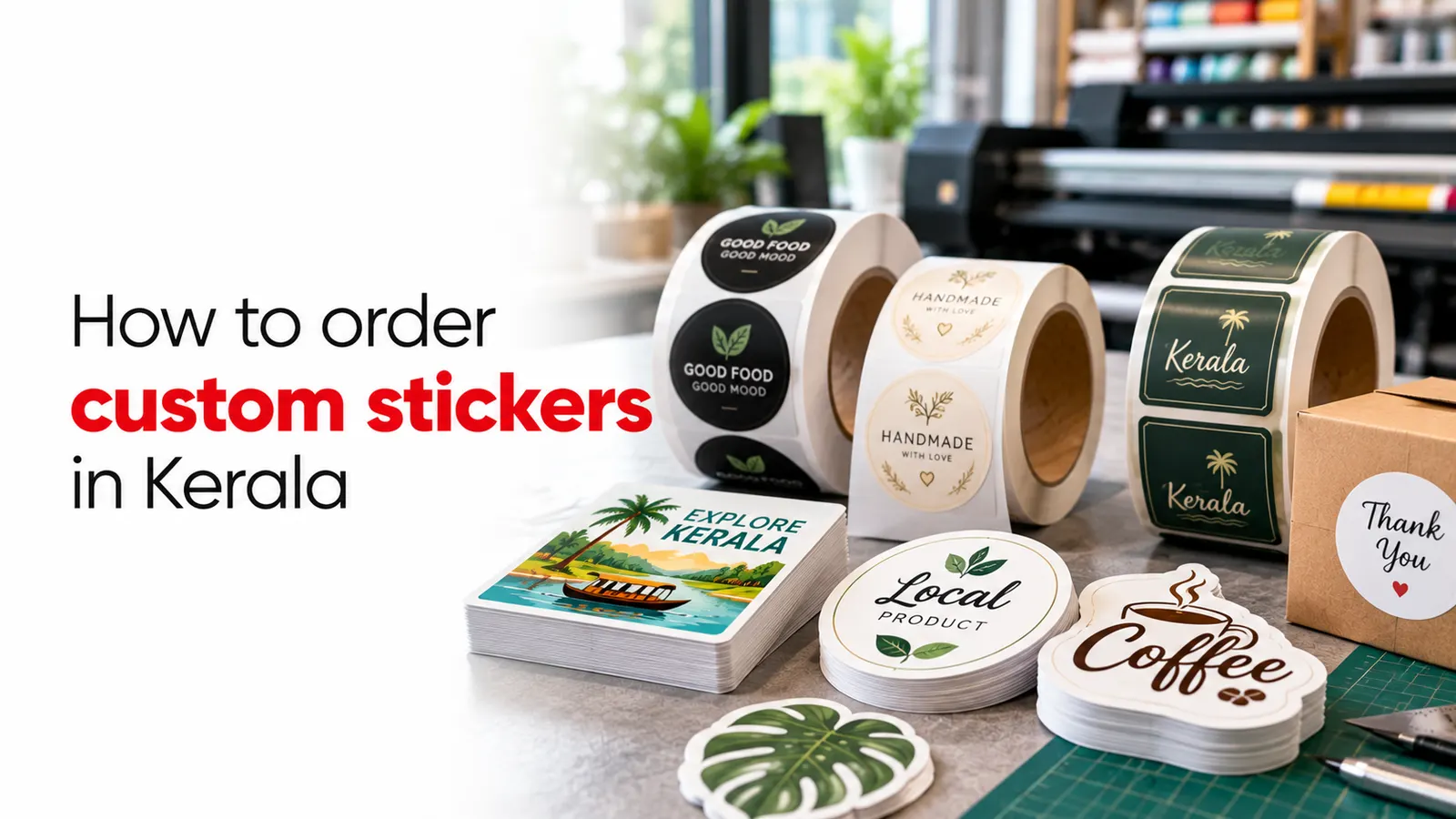
If you are wondering how do I order custom stickers in Kerala, the answer follows six steps: prepare print-ready artwork, choose a material, pick a finish and cut style, decide on quantity, select a printer, and confirm turnaround before paying. Each step feeds directly into the next, and skipping any one of them is where delays and file rejections typically begin. This guide walks through the full sequence in the exact order you need it, so you can place a confident order the first time.
Getting the steps right matters more than it might seem. Wrong file setup leads to revision rounds and delays. Choosing the wrong material produces stickers that peel or fade within weeks. Not vetting your printer before paying is how you end up with a delivery that looks nothing like your artwork. Kerala now has a good range of options, from online printers with statewide delivery to local production partners such as GDMR Foundation in Thiruvananthapuram that manage everything from file review and material selection through to precision cutting, finishing, and dispatch.
What to take away from this guide
- File format first: Vector artwork (AI, PDF, EPS) is the only reliable choice for die-cut orders; raster files must be 300 DPI at final print size.
- Material decides durability: White vinyl with laminate handles outdoor, bottle, and high-handling use; paper is for dry indoor applications only.
- Finish affects protection: Lamination is the strongest barrier against water and scratching; varnish suits controlled indoor environments at a lower cost.
- MOQ starts low: Local digital printers in Kerala typically accept from 25 pieces; some online Indian printers go as low as 20.
- Confirm current rates directly with your chosen printer, as prices vary by supplier and are subject to change.
- Timeline varies by location: City-based local printers can complete simple jobs in one to three working days; online orders to rural Kerala destinations can take up to ten working days.
How do I order custom stickers in Kerala: step by step
Before diving into materials and finishing, the single most important step is getting your artwork into a format the printer can actually use. Custom sticker printing in Kerala, whether through a local studio or an online service, starts and ends with file quality. A well-prepared file moves through production without a single revision round; a poorly prepared one can add days to your timeline and additional charges to your invoice.
What file format does your sticker printer actually need?
Vector artwork vs high-resolution raster: which one to use
Vector files, specifically AI, PDF, EPS, and SVG formats, are the preferred format for sticker printing because they scale to any size without losing sharpness. Raster files such as PNG, TIFF, and JPG are acceptable only when supplied at 300 DPI at the final printed size, not at a smaller design size or screen-preview resolution. The most common mistake is exporting at 72 DPI and assuming it will print cleanly; it will not.
Ordering custom stickers in Kerala: file setup for bleed, safe area, and cut path
Every sticker file needs three distinct zones to print and cut correctly. Extend background artwork at least 3 mm beyond the cut line on every side: this is the bleed, and it prevents white edges caused by minor cutting tolerances. Keep text, logos, QR codes, and other critical details at least 3 mm inside the cut line: this is the safe area. For die-cut or kiss-cut orders, supply a single closed vector path on a separate layer, named CutContour or Thru-Cut, using a named spot colour set to overprint so the cutter reads it as an instruction rather than a printed element. An incorrectly set or missing cut path is one of the most frequent reasons printers send files back for revision before they touch the press.
CMYK colour mode and font embedding
Prepare your files in CMYK colour mode, not RGB, unless your printer specifically requests a conversion profile. Convert all fonts to outlines, embed all placed images, and keep the file at 100% final print size before exporting. A safe general-purpose export is a CMYK PDF with vector artwork, outlined fonts, 300 DPI raster elements, 3 mm bleed, 3 mm safe area, and a separate named spot-colour cut-path layer.
Which sticker material suits your use case?
White vinyl: the standard for most sticker orders
White vinyl is the default choice for the majority of custom sticker orders. It is water-resistant, handles outdoor exposure well, adheres cleanly to bottles, laptops, packaging, and smooth surfaces, and holds colour with greater saturation than paper stock. Transparent vinyl costs a little more but allows the sticker background to disappear against the surface it is applied to, which suits clear packaging and product labels where the "no-label" look matters. Vinyl stickers in Kerala are among the most requested formats precisely because of this durability advantage in humid coastal conditions.
Paper stickers: where they make sense
Paper is the lowest-cost option and performs well for indoor packaging, product labels on dry surfaces, sticker sheets, and any application where water exposure is not a concern. The cost saving over vinyl is real, but the limitation is direct: paper stickers will not hold up on anything that gets wet, is handled frequently, or is stored in humid conditions. If there is any doubt about the environment, choose vinyl.
Holographic, metallic, and specialty films
Holographic vinyl is a flexible PVC film with a micro-embossed prismatic surface layer that separates reflected light into shifting, iridescent colours. It adheres best to clean, smooth, non-porous surfaces: glass, metal, smooth plastic, finished wood, laptops, phone cases, and coated product packaging. The right applications include premium packaging, limited-edition product labels, event giveaways, and brand merchandise where the sticker itself is part of the brand experience. Minimum order quantities for these films are often slightly higher than for standard vinyl.
What finish and cut style should you choose?
Lamination vs varnish: understanding the protection difference
Gloss lamination produces bright colours with strong water and scratch resistance, making it the right call for outdoor use, bottles, and high-handling applications. Matte lamination gives a reduced-glare, soft premium feel with equally solid protection. Both are plastic film options and represent the strongest barrier available. Liquid varnish adds light scuff and scratch resistance and can enhance colour, but it is not waterproof and offers less overall protection than a laminate film. If the sticker will be on a bottle, outdoors, or handled daily, laminate it. Varnish is a cost-saving choice only for controlled indoor environments.
Die-cut, kiss-cut, and sheet formats: which suits your order?
Die-cutting slices through both the vinyl and the backing liner, producing individual stickers in any custom shape with a clean, finished silhouette. The backing follows the sticker's exact contour, which looks premium but can be slightly harder to start peeling. Kiss-cutting slices through the vinyl only, leaving the sticker on a full backing sheet with a convenient border for easy peeling and neat presentation during storage and shipping. Sheet format arranges multiple stickers on one rectangular sheet and is typically the most economical cutting option.
Match each format to the use case: die-cut stickers in Kerala are popular for branded individual stickers and promotional giveaways; kiss-cut for sticker packs, retail packaging inserts, and planner sets; and sheet format for internal or bulk applications where presentation matters less than unit cost.
| Cut style | Best use case | Pricing impact |
|---|---|---|
| Die-cut | Individual branded stickers, giveaways, packaging inserts | Often costs more for small or individually packed runs |
| Kiss-cut | Sticker sheets, promotional packs, planner stickers, retail inserts | Often cheaper per sticker for sheets and large-volume orders |
| Sheet format | Internal use, bulk distribution, cost-sensitive orders | Lowest-cost cutting option |
How many stickers should you order, and what will they cost?
Minimum order quantities to plan around
Most local digital printers in Kerala accept orders from 25–50 pieces, and some will go as low as 10 pieces for simple rectangular labels. Among online Indian printers, some advertise MOQs as low as 20 pieces for custom vinyl stickers with pan-India delivery. Common MOQs from online printers range from 25 to 100 pieces; holographic and specialty films often require 50 pieces or more. Sheet-based printers may quote by the number of A3 sheets rather than individual sticker count. Industrial roll printers typically require 2,000 pieces or more and are not suitable for small or medium runs.
Price per unit at different order sizes
The per-unit cost drops sharply between 50 and 250 pieces because setup costs, including artwork preparation, printing, trimming, and packing, are spread across more units. Confirm all pricing directly with your chosen printer, as rates vary by supplier and are subject to change.
Costs that can catch you out
Several extras are sometimes excluded from headline quotes. GST is commonly charged at 18% for printing services and may not be included in the per-unit price shown, confirm this with your vendor or tax adviser. Delivery charges are calculated by weight and destination pincode and vary considerably. Ask for an all-in quote that specifies finished size, material, finish, cut type, quantity, number of designs, GST, and delivery before confirming the order.
How do you choose a sticker printer in Kerala and place the order?
Online printers with statewide delivery
Several online printers ship to Kerala pincodes across the state. The ordering process typically involves uploading artwork, selecting specifications (size, material, finish, quantity), approving a digital proof, and paying online. Delivery is typically five to ten working days door to door, with rural destinations toward the longer end of that window. These services work well for buyers who have print-ready files, are comfortable with digital proof approval, and do not need in-person consultation or file support.
Local production partners for full-service orders
A local end-to-end partner is the better choice for buyers who need file review support, material consultation, faster turnaround, or visibility into production at each stage. The ideal local partner handles in-house digital and UV printing, precision contour cutting, lamination and finishing, and direct dispatch without relying on multiple subcontractors. GDMR Foundation in Thiruvananthapuram operates exactly this kind of integrated print production setup, managing the process from file review and material selection through to cutting, finishing, and delivery across Kerala and beyond.
What to confirm with any printer before paying
Before transferring payment, confirm the following in writing: finished sticker size, material and finish specified, cut type, quantity, number of designs in the order, whether the quoted delivery time includes production or is transit-only, GST inclusion, and the proof approval process. These are the non-negotiables, and a printer who cannot confirm them clearly in writing is a printer worth reconsidering.
How long does production and delivery take across Kerala?
City-based orders in Thiruvananthapuram, Kochi, Kozhikode, and Thrissur placed with a local printer can be completed in one to three working days for simple jobs; three to five days is the standard for commercial sticker work. Online printers shipping within Kerala typically quote five to ten working days total, including production.
Transit times vary considerably by destination. Locations close to Thiruvananthapuram, such as Kollam, Neyyattinkara, and Attingal, can expect courier transit of one to three working days on top of production time. Central Kerala destinations including Alappuzha, Kottayam, and Kochi run two to four working days in transit. Northern Kerala cities such as Kozhikode, Kannur, and Kasaragod add three to five working days of courier transit. Rural and interior destinations, including Idukki, Kottarakara, and remote Palakkad areas, should allow seven to ten working days and sometimes longer depending on the carrier and pincode.
If your deadline is under 72 hours, a local printer with in-house cutting is usually the most reliable route. Send print-ready artwork before calling, request a written production timeline, and confirm whether the job requires pickup or can be couriered same-day within the city.
Placing your custom sticker order with confidence
Now you know how do I order custom stickers in Kerala, the six-step sequence is straightforward once you know it: sort the artwork to spec first, make the material and finish decisions before contacting any printer, get clarity on MOQ and all-in pricing including GST and delivery, then choose between an online service or a local end-to-end partner based on your timeline and the level of support you need.
The difference between a smooth sticker order and a frustrating one almost always comes down to file preparation and printer selection. A production partner who checks your files, advises on materials, and manages cutting and delivery in one place removes most of the friction. Whether you are ordering 50 personalised stickers in Kerala for a product launch or a 1,000-unit label run for retail distribution, that kind of integrated capability, covering custom sticker printing from artwork review through to finished delivery, is what to look for.
If you are based in Kerala or running a campaign across South India, get in touch with the team at GDMR Foundation. We handle the full workflow, from file review and substrate selection to precision cutting, lamination, finishing, and dispatch, so your stickers arrive on time and on spec.
Frequently asked questions
What are the steps to order custom stickers in Kerala?
Prepare print-ready artwork, choose the material, select the finish and cut style, decide the quantity, and choose a printer. Before paying, confirm the specifications, total cost, proof approval process and production and delivery timelines in writing.
Which file format should I use for custom stickers?
Supply vector artwork in a format your printer accepts, such as AI, PDF, EPS or SVG. If raster files such as PNG, TIFF or JPG are accepted, supply them at 300 DPI at the final printed size. Confirm the printer’s requirements before submitting artwork, as rejected files can lead to revisions, additional charges and delays.
How should I set bleed, safe area and the cut path for sticker files?
Unless your printer specifies otherwise, extend background artwork 3 mm beyond the cut line and keep text and logos at least 3 mm inside it. For die-cut or kiss-cut stickers, supply a closed vector cut path separately from the printed artwork. Follow the printer’s exact instructions for the layer name, spot colour and overprint settings; naming conventions such as CutContour or Thru-Cut are not interchangeable across every production workflow.
Should I prepare sticker files in CMYK, and what should I do with fonts?
Use the colour mode and profile requested by your printer, typically CMYK for print-ready artwork. Convert fonts to outlines or embed them in the supplied file so text displays correctly and missing fonts do not alter the design.
Which sticker material is best for outdoor or high-handling use?
Laminated white vinyl is a common choice for outdoor signage, bottles and frequently handled products. Confirm that both the material and adhesive are suitable for the intended surface and exposure to water, sunlight or refrigeration. Standard paper stickers are better suited to dry indoor applications where water resistance is unnecessary.
Should I choose lamination or varnish for sticker finishing?
Lamination generally offers greater protection against moisture, scratching and frequent handling, making it suitable for demanding applications. Varnish can be a lower-cost option for lighter-use indoor stickers. Ask the printer which finish is compatible with your chosen material and intended use.
What are the minimum order quantities and turnaround times for stickers in Kerala?
Minimum quantities and lead times vary by printer, material, quantity and cutting requirements. Confirm production time and delivery time separately, including whether the schedule starts after artwork approval. For a deadline within 72 hours, ask a local printer with in-house cutting to confirm feasibility in writing and agree on pickup or delivery arrangements before placing the order.
How should we pay for a sticker order in Kerala?
Use the printer’s agreed payment method, such as online checkout or bank transfer. Confirm whether full payment or a deposit is required, when any balance is due, and whether artwork checks or proofing happen before or after payment. Keep the written order confirmation and payment receipt.
Can we see a proof before payment or production starts?
Request a digital proof and confirm whether the printer supplies it before or after payment. Check the artwork, dimensions, spelling and cut-line placement before approving production. Also confirm how proof revisions affect the delivery schedule and whether the quoted turnaround begins only after approval.
Will GST and delivery be included in the quoted sticker price?
Do not assume they are included in the advertised price. Request an itemised quotation covering finished size, material, finish, cut type, quantity, number of designs, applicable GST and delivery. Ask whether artwork corrections, proof revisions or urgent production attract additional charges so the total cost is clear before payment.