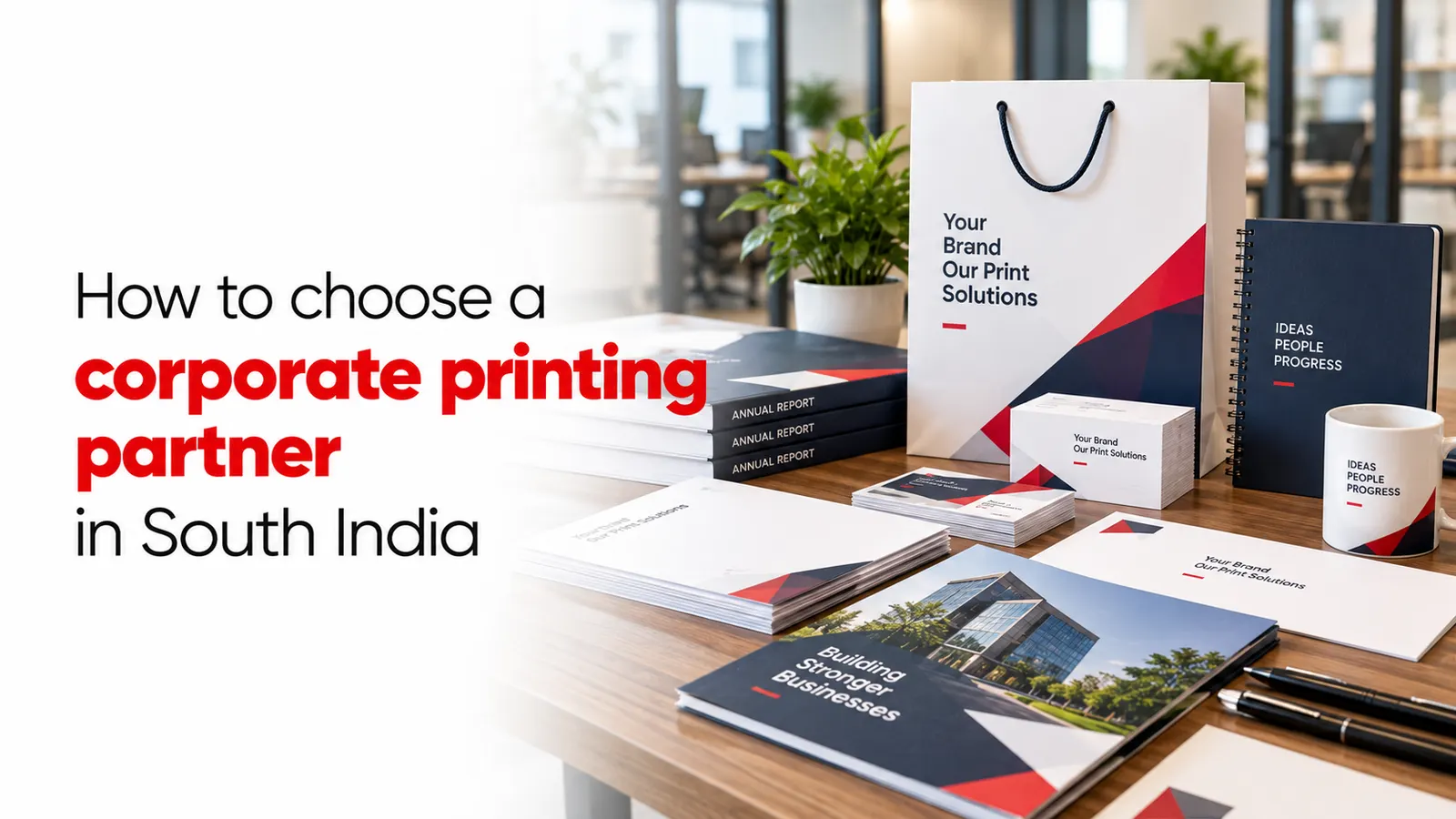
How to choose a corporate printing partner in South India
When it comes to corporate printing in South India, the right partner comes down to five criteria: the range of materials and formats they handle, their turnaround consistency at your run sizes, how they maintain quality across bulk orders, whether they operate as an integrated facility or as a series of disconnected vendors, and what verifiable trust signals they can show you. Cover these five before you request a single quote, and the shortlisting process becomes straightforward.
Corporate teams across Bengaluru, Chennai, Hyderabad, and Kochi often lose time and money by choosing a print partner on price alone, only to discover mid-campaign that the vendor can't handle a second format, doesn't hold consistent colour across a 2,000-piece run, or can't deliver to multiple office locations on time. This guide, produced by GDMR Foundation, an integrated printing, signage, and campaign execution company based in Thiruvananthapuram, walks through every criterion that matters for corporate printing South India, including what realistic pricing looks like, so your team goes into vendor conversations fully prepared.
What to know before you start
- Format range is non-negotiable: A partner who handles only brochures and letterheads may struggle or require subcontracting the moment you add signage or event materials.
- Quality signals require verification: Request ISO certificates with certificate numbers and expiry dates, not just logos on a vendor's website.
- Integrated production protects brand consistency: A single facility managing print, cut, fabricate, and finish eliminates colour drift and accountability gaps.
- Sustainability has a defined cost: FSC-certified paper typically adds 3–8% to the paper component of a job, according to Alibaba's Indian printing cost guide (current edition).
- Structured vetting saves time: Send the same written questions to every shortlisted vendor and evaluate how specifically they respond.
Corporate printing South India: does your print partner cover the formats your team actually needs?
The most common mistake corporate teams make when choosing a printer is treating format range as a given. Brochures and letterheads are table stakes. What separates a capable partner from a limited one is whether they can handle your full brief, from a 48-page annual report to a set of office wayfinding signs, without routing work to three different suppliers.
Every time a job transfers between vendors, you absorb coordination time, risk a colour or finish mismatch, and lose accountability when something goes wrong. A single facility that handles commercial digital printing, large-format output, rigid substrate printing, and basic signage fabrication keeps brand consistency intact and reduces the number of stakeholders your team manages. This matters especially for marketing departments running parallel campaigns across multiple formats, a scenario common in South India corporate printing across the larger metro markets.
Corporate teams typically plan for brochures, catalogues, and stationery. What they underestimate: presentation folders, bound reports, conference backdrops and standees, internal office signage, and point-of-sale materials for retail-adjacent departments. A partner who handles only paper and flex is not equipped for the full calendar of a mid-sized corporate marketing team.
Before committing, ask the printer to list every substrate they print on in-house, clarify which finishing steps are done on-site versus outsourced, and request a portfolio sample that shows corporate multi-format production. Outsourced finishing is not a disqualifier, but it must be disclosed so your team can factor it into turnaround expectations.
What turnaround times and pricing actually look like for corporate print jobs in South India
Turnaround and pricing vary significantly by job type, run size, and finish. Vendors commonly quote a headline figure that does not reflect a realistic timeline inclusive of proofing, approval, and finishing. Understanding realistic brackets before you approach corporate printing vendors in South India prevents costly misalignment between your campaign schedule and a printer's actual capacity.
Offset vs digital: choosing the right process
Digital printing suits runs under approximately 500 units where fast turnaround matters more than the lowest cost-per-piece. Offset becomes economical at higher volumes because setup costs are spread across more copies, reducing the per-unit price substantially. According to Sivakasi Offset Printing's India pricing data, a standard multi-page brochure (longer than four pages) runs roughly ₹9,000–₹16,000 on digital versus ₹7,000–₹12,000 on offset at 500 copies; at 2,000 copies, offset delivers a significantly better per-unit outcome. Clarify which process your vendor proposes for each job type, and confirm whether a colour proof is included in the quoted price.
Add 18% GST (the standard Indian GST rate for printed goods) and freight to every figure unless your quotation explicitly states otherwise. Design preparation or artwork corrections are almost always billed separately. According to Printigly's Bengaluru pricing guide, budget ₹8,000–₹15,000 for a standalone corporate profile design if your artwork is not print-ready.
How to verify quality consistency before placing a large order
Price and turnaround mean little if a vendor cannot hold consistent colour, finish, and dimensional accuracy across a run of 1,000 or 2,000 pieces. Quality consistency is the criterion most corporate teams skip during vendor selection, and it is the one that causes the most expensive reprints and missed deadlines.
What to request: certificates and quality signals
ISO 9001 certification is the most useful quality indicator. Request the actual certificate, not a logo on the vendor's website, and confirm the certificate number, scope, certifying body, and expiry date. Among verifiable South Indian options, Pioneer Print and Packaging in Coimbatore and Druck Media both publicly claim ISO 9001:2015 certification.
For publicly available rating signals, Annapurna Graphics and Printers in Andhra Pradesh carries 4.8 out of 5 from 131 listed reviews according to Trustindex, the strongest review volume in publicly available South Indian data. In Kerala, OREXIS Digital in Kozhikode holds a 5.0 rating from 15 reviews according to Sortlist, and Blue Star Printers in Chennai publishes a 4.6 out of 5 customer-rating page on their own platform. Treat marketplace ratings as a screening signal, not a substitute for certificate verification or physical sample review.
Before approving a purchase order, ask every shortlisted vendor for a physical sample produced on the same paper grade, GSM, ink, and finish specified for your job. Request a written proofing policy covering how colour approval is handled, who owns the cost of a reprint if a production error occurs, and what the turnaround on a corrected run is. A vendor confident in their quality process will answer these questions without hesitation.
Why integrated production capability is the real differentiator for corporate teams
Most corporate teams work with multiple vendors simultaneously: one for commercial printing, another for large-format banners, a third for office signage, and a fourth for event materials. Each handoff introduces a risk of colour mismatch, a delay, or a gap in accountability. An integrated facility that manages production from print through cut, fabricate, finish, and deliver removes these friction points from your workflow.
A genuinely integrated facility handles commercial digital printing, large-format output, rigid substrate production, precision cutting and fabrication, lamination and finishing, and packing and dispatch, all under one production roof. GDMR Foundation's printing unit in Thiruvananthapuram operates on exactly this model, covering everything from 48-page corporate catalogues and business stationery printing South India clients require, through to office signage, retail displays, and event structures, within a single integrated workflow.
When a brochure, an office signage system, and an event backdrop are produced by three different vendors, colour consistency across those materials is left to chance. A single facility working from one set of approved brand files, using consistent ink profiles and material standards, produces materials that look like they belong to the same brand system. For corporate teams managing brand governance across offices or retail environments, this is not a cosmetic benefit, it is a direct risk-reduction measure.
If your team's requirements include three or more print formats in the same campaign period, or if you manage multi-location delivery with centralised quality control, the coordination cost saved by an integrated partner can often exceed any per-unit price difference compared with a single-format vendor.
Sustainability options: what they cost and how to request them
Sustainable printing is increasingly requested by listed companies, ESG-conscious organisations, and brands targeting environmentally aware audiences. South Indian commercial printers are beginning to offer FSC-certified paper, vegetable-based inks, and water-based coatings, but availability and pricing vary considerably by vendor and specification.
According to Alibaba's Indian printing cost guide (current edition), FSC-certified paper typically costs 3–8% more than a conventional paper grade of comparable GSM, which translates to approximately 1–5% on the total job cost when paper represents 40–60% of the print price. Recycled or eco-friendly paper runs approximately 10–15% above standard paper, according to Paper Print Services. A full sustainable specification combining FSC paper and eco inks is best budgeted at 5–15% above your conventional quote, depending on run size, GSM, colour coverage, and finishing. Indian paper suppliers such as TNPL in Tamil Nadu, ITC Paper, and BILT Green are accessible through South Indian distributors for FSC and recycled grades.
Specify in writing when requesting a sustainability-compliant quotation: the FSC chain-of-custody licence number of the paper supplier, the ink type, any coating type (water-based versus solvent-based), and whether you need a final product that can carry an FSC on-product claim. Ask the vendor to break out the paper cost separately so you can see the actual premium rather than an absorbed figure.
A practical framework for shortlisting and vetting corporate printing vendors in South India
With criteria defined and pricing benchmarks understood, the shortlisting process becomes a structured exercise rather than a comparison of whoever quotes lowest. Match your primary job type to vendor speciality before you issue a brief to more than three vendors.
For routine stationery and brochures ordered online with fast fulfilment, Quapri serves Chennai, Bengaluru, Hyderabad, Kochi, and Coimbatore with pan-India online ordering. For multi-city corporate branding, gifting, and wall graphics with installation, ARC India has confirmed offices in Bengaluru and Chennai and lists coverage across the five major South Indian cities. For high-volume bound annual reports requiring offset capability and finishing infrastructure, focus on facilities that can demonstrate offset press capacity alongside binding. For multi-format corporate production including signage and event materials, the full scope of corporate large-format printing South India campaigns typically demand, an integrated facility is the correct match. Geography matters for installation-dependent jobs, so confirm whether the vendor has a local crew or a verified installation partner at your destination city.
Questions to send every shortlisted vendor
Send these questions in writing and evaluate how completely and specifically each vendor responds:
- What is your in-house production capability versus outsourced steps?
- Can you provide a physical, job-specific sample on our specified paper and finish before we confirm the order?
- What is your proofing process, and what is your reprint policy if a production error occurs?
- Do you hold ISO 9001 or any other quality certification, and can you share the current certificate with certificate number and scope?
- What are your minimum order quantities, and how does pricing change between 500 and 2,000 units for our job type?
- What is your delivery or installation capability at our specific locations, and is freight included in your quoted price?
When two vendors meet your quality and format criteria at similar price points, the decision comes down to turnaround reliability, single-point accountability, and scalability. A vendor who answers vetting questions with specifics, provides a job-specific sample promptly, and outlines a clear proofing process is demonstrating exactly the production discipline you need before a deadline.
The right corporate printing partner in South India reduces cost, rework, and coordination time from the first job
Choosing a corporate printing partner in South India is straightforward once you know what to evaluate. Start with format capability and material range, verify quality signals before you place a bulk order, understand what turnaround times and pricing actually look like for your specific job type, and factor in sustainability requirements early so they don't become a last-minute negotiation.
For teams with multi-format needs spanning commercial print, signage, and event materials, an integrated facility that manages production end to end will consistently outperform a collection of single-format vendors on consistency, accountability, and total coordination cost. GDMR Foundation's printing unit in Thiruvananthapuram handles production across paper, vinyl, acrylic, ACP, fabric, and other substrates through a single workflow covering printing, cutting, fabrication, finishing, packing, and campaign installation, the kind of integrated model that removes coordination overhead from your team's calendar.
Use the pricing benchmarks and vetting questions in this guide to build your shortlist for corporate printing South India, then get in touch with our team to discuss your specific brief. The right facility becomes clear once you're asking the right questions.
Frequently asked questions
How do I choose a corporate printing partner in South India?
Assess five areas: the materials and formats they handle, turnaround reliability at your required quantities, quality control across bulk orders, coordination between production stages, and verifiable credentials and references. Prioritise partners whose capabilities match your recurring corporate printing needs.
What format range should a full-service corporate printer cover?
Depending on your requirements, look for brochures, letterheads, presentation folders, bound reports, large-format graphics, conference backdrops, standees, rigid substrate printing, signage fabrication and point-of-sale materials. Ask for samples demonstrating the formats you need and a clear breakdown of what the vendor produces in-house.
How do I verify a printer’s quality and credentials?
Review physical samples of comparable corporate work and check references from previous clients. If a vendor claims ISO certification, request the actual certificate, including its number, scope, certifying body and expiry date, rather than relying on a website logo. Consider certification alongside the quality of their output and their documented production checks.
What turnaround and consistency checks should I make for bulk runs?
Request written production timelines for your actual quantities and specifications. Ask how the printer checks colour consistency throughout a large run and handles output that does not match the approved sample. For deliveries to multiple offices, confirm quantities, dispatch dates and delivery arrangements for each location, including whether outsourced stages could affect the schedule.
Is it better to use an integrated production facility or several specialised vendors?
An integrated facility can simplify coordination by managing printing, cutting, fabrication and finishing through one production team. Several specialist vendors may suit projects requiring capabilities unavailable from one supplier, but someone must coordinate specifications, schedules and approvals. In either arrangement, establish who is responsible for the finished job and for resolving mismatches or defects.
How much extra should we budget for FSC-certified paper?
The price difference depends on the paper specification, quantity and supplier, so request comparable quotations using conventional and FSC-certified stock. Ask the printer to show the difference in both paper cost and total job cost, with any alternative inks or finishes priced separately. Request relevant FSC certification details and documentation covering the paper supplied.
What does a structured shortlisting process for corporate printers look like?
Start with around three vendors whose specialities match your main requirements. Send each the same written brief covering formats, materials, quantities, finishing and delivery locations. Compare their quotations, samples, proofing policies, production arrangements and responses using the same criteria. This makes it easier to identify differences in scope and responsibility before awarding the work.
When should we choose digital printing versus offset printing?
Digital printing often suits shorter runs and tight deadlines, while offset can become more economical at higher volumes as setup costs are spread across more copies. The crossover depends on the job, so avoid treating 500 copies as a universal cutoff. Ask the vendor to recommend and quote the appropriate process for your quantity, paper and finishing requirements, and confirm whether a colour proof is included.