What Is UV Printing and How Does It Work in South India?
How does UV printing work in South India? UV printing is an inkjet process where UV-reactive ink is deposited onto a surface and instantly solidified using ultraviolet light, no drying, no evaporation. The moment UV light strikes the ink, a chemical reaction called photopolymerisation converts liquid ink into a hard polymer film. That is precisely why it bonds to acrylic, glass, metal, wood, and dozens of other rigid or flexible surfaces that standard printing cannot touch. For any South Indian business evaluating UV printing vendors, whether retail brand, agency, or corporate marketing team, understanding this process changes how you brief, specify, and buy. This guide covers the full picture: how ink cures, which substrates it suits, what finish options are available, and how South India's climate specifically affects quality and durability.
Key takeaways
- Instant curing, not drying: UV ink is chemically converted into a solid polymer by ultraviolet light, not by evaporation, which enables adhesion on non-porous surfaces.
- Lamp type matters: Mercury lamps offer broad-spectrum curing; UV LED systems run cooler and suit heat-sensitive substrates like thin acrylic and PVC.
- Substrate preparation is non-negotiable: Cleaning, priming, and surface activation directly determine whether a UV print lasts or peels.
- South India's climate adds specific risks: Heat, monsoon humidity, and coastal salt air accelerate adhesive failure, edge lifting, and pigment degradation if not properly mitigated.
- Outsourcing is often the more practical choice: For most retail brands and agencies, partnering with an integrated UV facility reduces capital and technical burden significantly.
How does UV printing work in South India: the core process
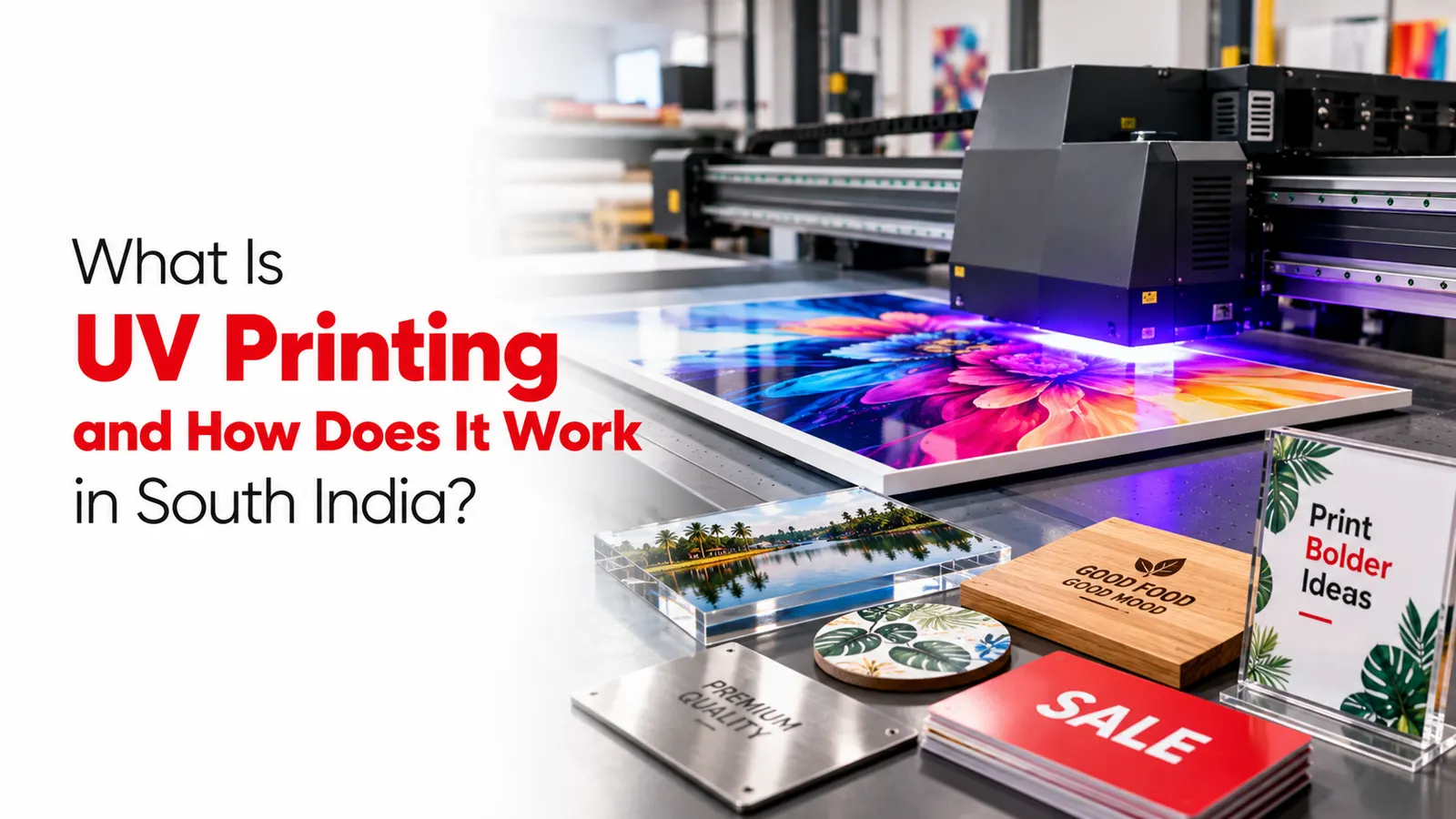
UV printing uses piezoelectric printheads to eject precisely metered droplets of UV-reactive ink onto the substrate in overlapping dot patterns. Unlike solvent or aqueous inks, UV ink does not evaporate to dry. It stays liquid until struck by ultraviolet light, which triggers photopolymerisation and converts the ink instantly into a hard polymer film sitting on the substrate surface rather than soaking into it. That surface-bonding behaviour is exactly what makes it adhere to non-porous materials.
The production sequence runs as follows: artwork is rasterised by RIP software into channel-separated dot data, the substrate is positioned flat on the print bed, and ink is ejected in CMYK layers with a white underbase applied first where needed. Inline UV lamps mounted beside the printhead illuminate freshly deposited ink after each pass, progressively curing the layers until the job is complete.
The chemistry is worth understanding in practical terms. UV ink contains pigments, acrylate monomers, oligomers, and photoinitiators. When ultraviolet photons strike the photoinitiators, reactive radicals form and attack the acrylate molecules, causing rapid cross-linking into a solid polymer network. This is not drying; it is a chemical conversion. The result is a tough, scratch-resistant film with immediate adhesion and gloss. Incomplete curing, from the wrong lamp wavelength, too-fast carriage speed, or excessively thick ink layers, leaves a tacky surface that fails in use.
Mercury lamp vs UV LED: which curing system suits your application?
Mercury-vapour lamps emit a broad UV spectrum that activates a wide range of photoinitiators and can penetrate pigmented or heavily loaded ink layers. UV LED printer systems emit a narrow band, typically 365 to 405 nm, and require inks specifically formulated to absorb that wavelength. The practical difference is significant: mercury lamps generate substantial heat and need warm-up time, while UV LED modules run cool, switch on and off instantly, and have a longer service life.
For heat-sensitive substrates like thin acrylic sheets or PVC film, LED systems are markedly safer because they transfer far less thermal energy to the material. For the kind of work common in South Indian retail branding and signage, including acrylic display panels, ACP fascia boards, and branded glass partitions, UV LED systems are increasingly preferred for their substrate compatibility, lower running cost, and longer maintenance intervals.
Mercury lamp systems can still deliver strong curing performance on certain pigmented or white-ink-heavy applications, provided the ink formulation is matched correctly to the lamp spectrum. The key question to ask any UV printing vendor is which lamp technology they run and whether their ink formulations are designed for that specific system. An ink formulated for mercury lamps can cure poorly or inconsistently under an LED without reformulation, even when the total UV dose appears sufficient.
Which materials can UV printing handle, and how do you prepare them?
| Substrate | Common applications | Key preparation requirement |
|---|---|---|
| Acrylic / PMMA | Display panels, retail standees, awards | Remove protective film and adhesive residue; clean with IPA; primer or plasma treatment if adhesion is marginal |
| Aluminium composite panel (ACP) | Exterior signage, fascia boards, architectural panels | Degrease thoroughly; remove protective film; bare or anodised aluminium may need light abrasion and metal primer |
| Glass | Decorative interiors, branded partitions, awards | Intensive cleaning with IPA or approved glass cleaner; glass primer or silane coupling agent for outdoor or handling durability |
| Wood / MDF | Display fixtures, décor panels, branded furniture | Sand smooth, remove dust, seal with compatible primer or UV sealer before printing |
| PVC board / foam board | Indoor signage, temporary displays | Clean surface; low-energy PVC may benefit from corona or plasma treatment |
| Vinyl and flexible films | Labels, window graphics, vehicle graphics | Remove silicone, plasticiser migration, and release agents; use flexible ink and curing settings |
Substrate preparation is where UV print quality is won or lost. Acrylic needs protective film removed immediately before printing and cleaning with a non-aggressive solvent; cast acrylic generally prints directly, but extruded acrylic or difficult finishes may need a primer. Glass requires intensive degreasing and typically a glass primer or silane coupling agent for applications involving outdoor exposure, moisture, or regular handling. ACP preparation depends entirely on whether the print face is factory-coated, anodised, or bare aluminium, each behaves differently and must be qualified separately.
Wood and MDF must be sealed before printing to prevent ink absorption and colour unevenness. When MDF goes to press unsealed, ink penetrates the fibre structure unevenly, creating patchy colour and visible grain bleed that cannot be corrected after curing. The broader rule across all these materials is that "UV printable" does not automatically mean permanently durable. Always test adhesion on the actual material under actual production conditions before committing to a full run, particularly for outdoor or coastal installations.
What finish options does UV printing unlock beyond standard colour?
White ink is one of the most powerful differentiators in UV printing, and many buyers underestimate how much it changes the output. On clear acrylic, a white underbase beneath colour layers creates a backlit display effect that is impossible without it. On dark substrates, white ink restores full opacity. On glass, it produces frosted or opaque decorative panels. For retail point-of-sale displays and architectural graphics, white ink is often not optional but essential for the design intent to function.
Beyond white ink, UV printing unlocks a range of specialty finishes that standard printing cannot replicate. Spot UV varnish involves printing clear UV varnish selectively over a matte background, creating sharp tactile contrast between surface zones. Raised texture builds up multiple clear ink layers to produce a physically tactile surface. Matte and high-gloss finishes are achievable through ink formulation and laminate combinations. These finishes are increasingly requested by premium retail brands for POS displays, award products, and branded architectural elements.
Not every UV printer or facility can deliver these specialty layers. The equipment needs the correct ink channels and RIP capability to execute multi-pass clear varnish and texture work. When briefing a UV printing vendor on premium retail or display applications, confirm specifically which specialty channels and finish options their system supports before sending artwork.
How South India's climate affects UV printing: heat, humidity, and coastal conditions
South India presents three distinct environmental stresses that directly affect UV printing quality and outdoor durability: high ambient heat, monsoon humidity, and coastal salt air. Heat lowers ink viscosity, accelerates nozzle clogging, and causes substrates to expand and contract in ways that stress the cured film over time. It also accelerates outdoor pigment degradation on long-term installations.
Monsoon humidity introduces a separate set of risks. It promotes surface condensation on cold substrates brought into warm production spaces, causes hygroscopic materials like wood and paper to warp, and can produce blistering or edge lifting where moisture is trapped beneath a cured film. Coastal salt air compounds these problems further, it keeps print surfaces damp and accelerates under-film corrosion on metal substrates and sign frames. For businesses running UV-printed outdoor graphics across coastal cities in Kerala, Tamil Nadu, and Andhra Pradesh, these factors directly shorten display service life if materials and installation methods are not properly specified.
Managing these risks involves practical steps at both the print room and installation stage. Control the print environment at 40 to 60 per cent relative humidity, particularly through monsoon months. Condition substrates in a dry room before printing to prevent condensation on panels brought in from outside. Specify ink and overlaminate systems rated for outdoor, high-UV, and high-humidity service. Seal substrate edges to prevent moisture ingress behind films and graphics. Apply a UV-resistant clear coat or laminate on all outdoor installations, and schedule periodic cleaning to remove salt deposits before they cause under-film damage. These are precisely the questions to put to any UV printing vendor before commissioning outdoor or coastal retail signage.
Should you invest in UV equipment or partner with an integrated UV facility?
Based on vendor pricing current in 2026, the equipment cost picture is straightforward.
Beyond the machine itself, a realistic budget must account for RIP software, power stabilisation, ventilation, white-ink circulation maintenance, substrate wastage during setup, and a reliable service contract. White ink in particular requires daily circulation, agitation, and purging; extended idle periods can cause costly clogging that smaller operations are poorly equipped to manage. A low-cost machine with weak local support can cost more in downtime than a higher-specified machine with dependable service.
For most retail brands, advertising agencies, and corporate marketing teams in South India, the more practical decision is to partner with a facility that already has substrate range, white-ink capability, specialty finish options, a climate-controlled production environment, and a complete post-print workflow in place. Building that infrastructure in-house demands capital, technical staff, and ongoing maintenance attention that few brand or marketing teams are set up to handle. GDMR Foundation's UV printing facility in Thiruvananthapuram is this kind of integrated production partner, handling UV printing across acrylic, ACP, glass, wood, and rigid boards with white-ink, texture, and specialty-finish capability, and serving retail brands, advertising agencies, and corporate marketing teams across South India. This means you avoid the operational complexity of managing equipment and coordinating across multiple vendors.
When evaluating any UV printing vendor, the checklist should cover substrate range, white-ink channel availability, finish options, whether the print environment is climate-controlled, and whether the facility can take a job from print through cutting, finishing, packing, and installation without handing off to multiple suppliers.
The bottom line: how UV printing works in South India
UV printing is a photopolymerisation-based process that cures instantly, adheres to a wide range of rigid and flexible substrates, and unlocks finish options, including white ink, raised texture, and spot UV varnish, that standard printing cannot deliver. Understanding how UV printing works in South India means accounting for both the technology itself and the regional conditions that affect it: preparation standards, climate mitigation, and equipment or partner selection.
For businesses operating across South India, substrate preparation and climate mitigation are not optional details. They are the difference between a display that holds for three years and one that delaminates in the first monsoon. The equipment investment is substantial, and the ongoing technical demands of managing white ink, curing calibration, and printhead health are real operational challenges that go well beyond simply owning a machine.
For most brand owners, agencies, and campaign teams across South India, the more practical path is working with a UV printing facility that has already solved those problems at scale and can deliver finished, installation-ready output. Get in touch with our team at GDMR Foundation to discuss your next UV printing requirement, whether a single retail display, a multi-location campaign rollout, or a specialty finish application requiring white-ink, texture, or multi-pass clear varnish capability.
Frequently asked questions
How does UV printing work in South India?
UV printing uses piezoelectric printheads to deposit UV-reactive ink as tiny droplets onto a substrate. Ultraviolet light then triggers photopolymerisation, converting the liquid ink into a solid polymer film. RIP software prepares the artwork, and CMYK inks, with a white underbase where needed, are printed and cured during production. The ink cures through this reaction rather than drying primarily through evaporation.
Which substrates can UV printing be used on?
UV printing can be used on acrylic, glass, metal, wood and compatible flexible films. However, adhesion is not automatic on every material. Suitability depends on the specific substrate, ink formulation, surface preparation and intended application.
What is the difference between mercury-vapour lamps and UV LED curing?
Mercury-vapour lamps emit a broad UV spectrum, while UV LED modules emit a narrower wavelength range and require compatible inks. Mercury lamps generate more heat and need warm-up time. UV LEDs switch on instantly, generally have a longer service life and produce less heat, making them useful for heat-sensitive substrates. In either system, the ink must match the curing source.
How should substrates, including glass, be prepared before UV printing?
Clean substrates thoroughly and use a compatible primer or surface activation treatment where required. Glass may need a specialist glass primer or silane coupling agent, particularly for outdoor panels or frequently handled items. Test adhesion on the actual material using the intended ink and finishing system. Preparation and curing both matter: poor preparation can cause peeling, while insufficient UV exposure or excessively thick ink layers can leave the print incompletely cured and tacky.
How should outdoor UV signage be specified for South India’s climate?
Account for heat, monsoon humidity, condensation and coastal salt exposure when choosing materials and finishes. Specify outdoor-rated substrates, inks with suitable colour stability, compatible primers where required and a protective clear coat or laminate where recommended for the application. Edge sealing and substrate conditioning may also be necessary, depending on the signage construction. Ask vendors about production temperature and humidity control, and request sample panels and outdoor weathering data to assess adhesion, finish and colour durability.
Should a South Indian brand outsource UV printing or buy its own equipment?
Outsourcing is often more practical for retail brands, agencies and corporate marketing teams because it avoids equipment investment and the ongoing demands of operator training, maintenance and process control. Before selecting a vendor, confirm their substrate capabilities, curing system, white-ink availability and finishing options. For multi-location rollouts, also check whether they can coordinate cutting, packing, delivery and installation. If considering in-house production, assess these responsibilities alongside equipment costs and expected workload.
How often does white ink need maintenance when printing jobs are intermittent?
Follow the printer manufacturer’s schedule for white-ink circulation, agitation, cleaning and purging. Intermittent production does not remove the need for maintenance, and extended idle periods can increase clogging risks. Exact procedures and frequency vary by machine, so confirm the required upkeep before buying equipment or appointing a printing partner.